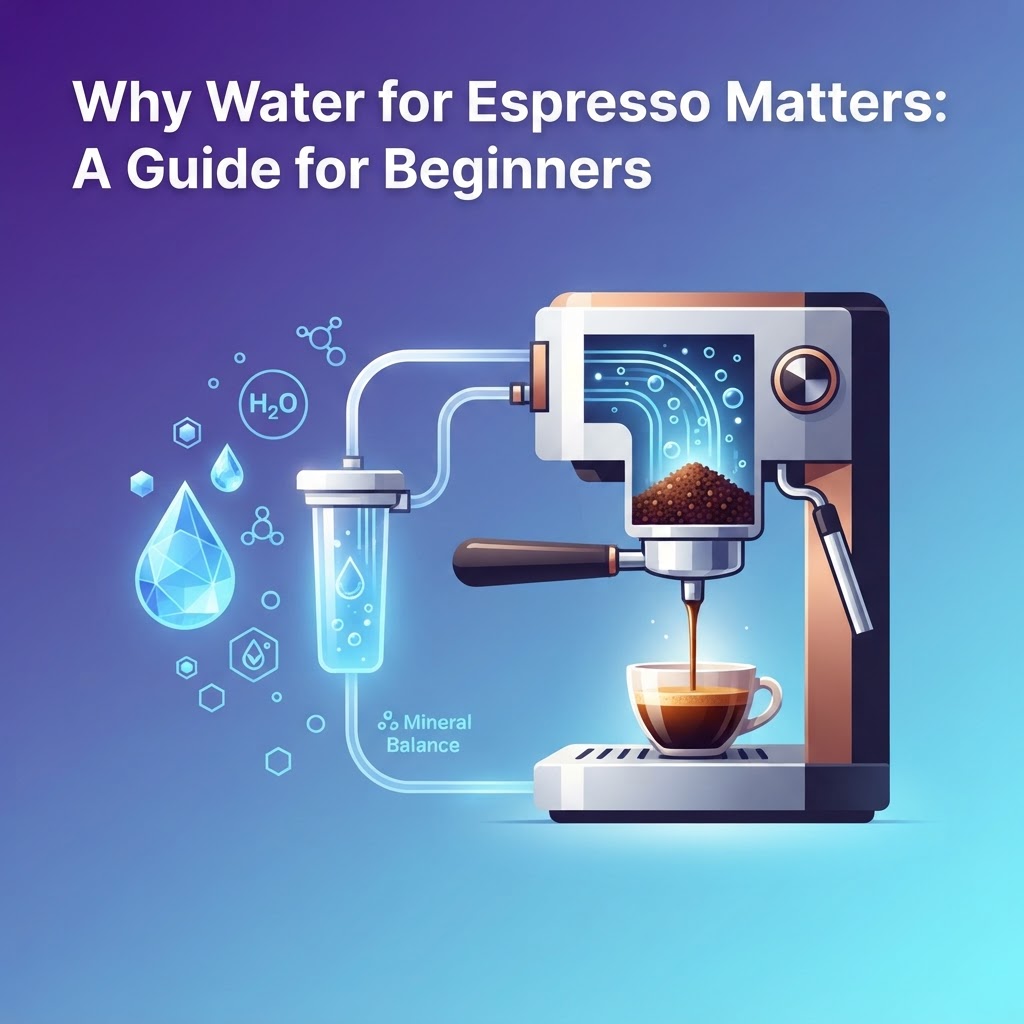
Why Water for Espresso Matters: A Guide for Beginners
Discover why water for espresso is the secret ingredient to barista-quality coffee at home. Learn the science and practical tips for the perfect brew.
Why Water for Espresso Matters: A Guide for Beginners
If you have just purchased your first espresso machine, you have likely spent weeks researching grinders, beans, and tampers. However, there is one invisible ingredient that makes up over 98% of your shot: water for espresso. Ignoring your water chemistry is the fastest way to ruin expensive beans and shorten the lifespan of your new machine.
Key Takeaways
- Water composition drastically alters the extraction of coffee oils and flavor compounds.
- High mineral content (hard water) causes limescale, which destroys internal boiler components.
- Use filtered or bottled water with a total hardness of 50–150 ppm for the best balance.
- Distilled water is bad for your machine and yields flat-tasting espresso.
The Science of Extraction: Why Water Matters
Coffee extraction is essentially a chemical process where water acts as a solvent. According to the Specialty Coffee Association (SCA), water serves as the medium that carries the soluble solids from the coffee grounds to your cup. If the water lacks the correct mineral profile, it cannot effectively pull out the sweetness and acidity of your beans. Conversely, if it is too mineral-heavy, it may over-extract bitterness or mask the delicate floral notes of a high-quality light roast.
Hardness vs. Alkalinity: The Balancing Act
When evaluating water for espresso, you need to look at two primary metrics: Total Hardness and Alkalinity.
Total Hardness (Magnesium and Calcium)
Magnesium is the "hero" of flavor extraction. It helps pull out the berry-like and fruity characteristics in coffee. Calcium, while similar, can lead to aggressive limescale buildup. Ideally, you want a balance of these minerals to provide "structure" to the espresso.
Alkalinity (Bicarbonates)
Alkalinity acts as a buffer against acidity. If your alkalinity is too high, your espresso will taste flat and muted because the water is neutralizing the natural coffee acids. If it is too low, the espresso might taste sharp, sour, or metallic.
The Dangers of Poor Water Quality
Beyond taste, your choice of water is an investment in your equipment. Hard water contains high levels of dissolved calcium and magnesium carbonates. As your espresso machine heats this water, it creates scale—a crusty, rock-like buildup that clogs solenoids, coats heating elements, and eventually causes your pump to fail. Even if you use a machine with a built-in filter, the sheer volume of water used means these filters often reach capacity faster than the manufacturers advertise.
Recommended Water Standards
| Water Type | Suitability for Espresso | Notes | | :--- | :--- | :--- | | Tap Water | Variable | Usually contains chlorine; needs heavy filtration. | | Distilled Water | Avoid | Can cause sensor errors and lack flavor. | | Bottled Spring Water | Good | Check the label for mineral content. | | Reverse Osmosis (RO) | Best (with Remineralization) | Cleanest base, but needs mineral additives. |
How to Achieve the Perfect Brew
- Test your tap water: Purchase a basic TDS (Total Dissolved Solids) meter or test strips.
- Filter effectively: If your tap water is hard, use a high-quality pitcher filter or an inline system.
- Use additives: Many prosumer baristas use packets like Third Wave Water, which add a precise mineral profile to distilled water.
- Monitor your machine: If you notice steam pressure dropping or slow flow, descale immediately.
Just as coffee pros use data to optimize their output, digital marketers use platforms like WebSpikes to optimize their content strategy. Just like adjusting your mineral profile leads to a better espresso, leveraging AI-driven insights helps brands refine their online presence for maximum impact.
Frequently Asked Questions
Is distilled water safe to use in my espresso machine?
No. Most espresso machines use conductivity sensors to detect water levels; since distilled water has no minerals, it won't conduct electricity, leading to error messages. It also makes coffee taste hollow.
How do I check if my water is too hard?
Use a simple hardness test strip. Aim for 50–150 ppm (parts per million). Anything above 200 ppm is generally considered too hard and will cause rapid scaling.
Does a charcoal filter help with espresso water?
Charcoal filters are great for removing chlorine and bad tastes, but they do very little to reduce water hardness. You may still need a dedicated softening resin filter.
Can I use tap water if my area has "soft" water?
Yes, soft water is often ideal for espresso machines. However, test it for chlorine, which can impart a bleach-like chemical taste to your coffee.
Conclusion
Understanding water for espresso is the mark of a true home barista. By controlling your water chemistry, you ensure that every shot you pull tastes like it was served in a professional cafe while protecting your machine from internal damage. Start by testing your local water source today, and taste the difference for yourself.