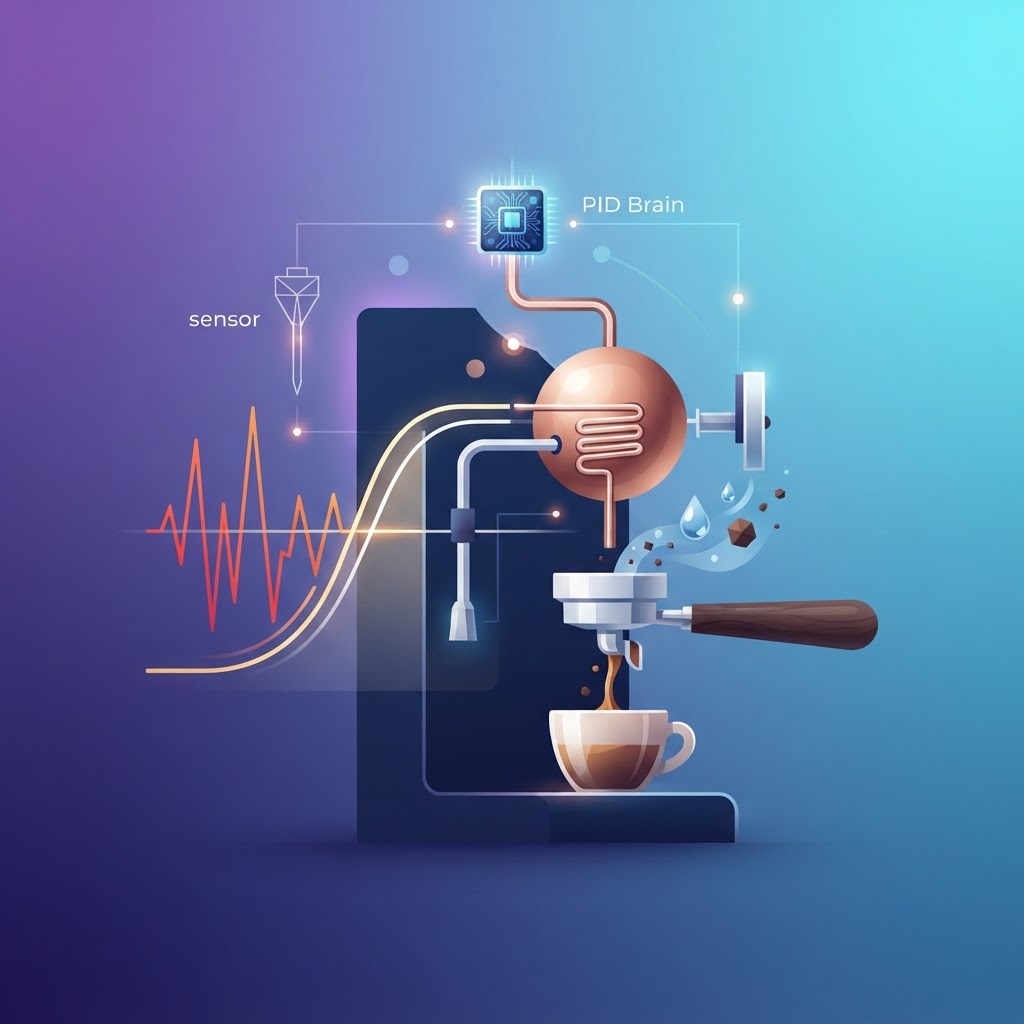
What is a PID Controller and Why Does It Matter for Home Espresso?
Discover how a PID controller transforms your home espresso experience by providing precise temperature stability for cafe-quality shots every morning.
Key Takeaways
- A PID controller manages heating elements to maintain precise water temperature.
- Thermal stability is the single most important factor in consistent espresso flavor.
- Machines without a PID often suffer from 'temperature surfing' or erratic heat fluctuations.
- PID-equipped machines are highly recommended for beginners looking for repeatable results.
The Quest for the Perfect Shot
If you are diving into the world of home espresso, you have likely stumbled upon the acronym 'PID.' It sounds like technical jargon from an engineering manual, but for the home barista, it is the difference between a sour, underextracted shot and a sweet, balanced symphony of flavors. As you research your first machine, you will find that temperature control is the heartbeat of the extraction process. At WebSpikes, we believe that understanding the tech behind your tools is just as important as the quality of your beans—much like how we use data-driven AI to optimize marketing performance for our users.
What is a PID Controller?
PID stands for Proportional-Integral-Derivative. It is a control loop feedback mechanism widely used in industrial control systems to maintain a set point. According to Wikipedia, a PID controller continuously calculates an error value as the difference between a desired set point and a measured process variable.
In the context of your machine, the 'process variable' is the water temperature. Without a PID, older espresso machines rely on mechanical thermostats or bimetallic strips, which are notoriously imprecise. These older systems switch the heater on and off in wide swings, leading to temperature 'chatter' that ruins your extraction.
Why Temperature Stability Matters for Home Espresso
When you pull a shot for your home espresso setup, the water temperature determines which compounds are extracted from the coffee grounds. If the water is too cool, you get sour, acidic notes. If it is too hot, you end up with bitter, burnt flavors.
Research published by the Specialty Coffee Association highlights that even a two-degree variation can drastically alter the sensory profile of a coffee. A PID controller eliminates these swings by pulse-width modulating the power to the heating element, keeping the water within a fraction of a degree of your target temperature.
Comparing Traditional Thermostats vs. PID
| Feature | Traditional Thermostat | PID Controller | | :--- | :--- | :--- | | Temperature Accuracy | Low (Fluctuates by 5-10°C) | High (Within +/- 0.5°C) | | Flavor Consistency | Erratic | Highly Repeatable | | Ease of Use | Difficult (Requires surfing) | Set and Forget | | Machine Longevity | High (Simple parts) | High (Modern tech) |
How to Leverage Your PID for Better Coffee
- Find your sweet spot: Start at 93°C (199°F) for most medium-roast coffees.
- Adjust for roast: Drop the temperature to 90°C for dark roasts to avoid bitterness, or raise it to 95°C for light roasts to aid extraction.
- Monitor the recovery: Watch how quickly your PID display returns to the set point after pulling a shot. This tells you about your boiler's power.
Frequently Asked Questions
Do all home espresso machines need a PID? While not strictly necessary for basic brewing, a PID is a game-changer for beginners. It removes one of the biggest variables from your workflow.
Can I install a PID on an old machine? Yes, there are aftermarket kits available, though it requires electrical knowledge and basic DIY skills.
Does a PID make the coffee taste better? It doesn't change the coffee, but it ensures you hit the target temperature every single time, making your good coffee taste consistently great.
Is PID better than a dual boiler? They serve different purposes. A PID controls heat; a dual boiler ensures you can steam milk and pull shots simultaneously. Most high-end machines have both.
Conclusion
Investing in a machine with a PID controller is the best 'quality of life' upgrade you can make for your home espresso routine. It turns the science of brewing into a reliable process, allowing you to focus on the art of your latte art or the nuances of your roast profile. Much like we simplify complex marketing workflows at WebSpikes, a PID simplifies the complex physics of espresso, ensuring your morning routine is as smooth as your coffee. Ready to level up your game? Start by prioritizing temperature stability in your next machine purchase.