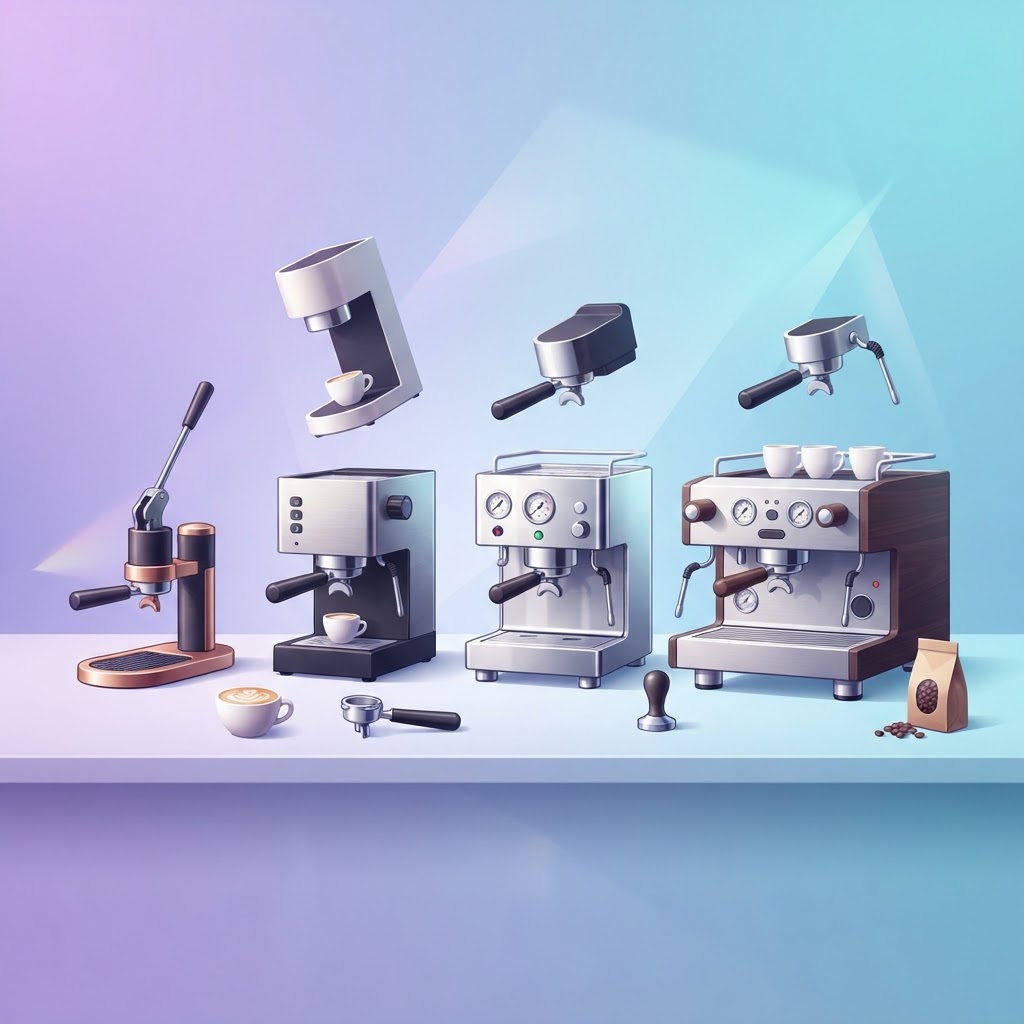
Espresso Machine Types Explained: A Beginner's Guide to Choosing Your Setup
New to coffee? Discover the different types of espresso machines, their features, and how to pick the perfect one for your home brewing journey.
Key Takeaways
- Manual machines offer total control but require significant skill.
- Semi-automatic machines are the industry standard for home baristas balancing convenience and craft.
- Fully automatic and super-automatic machines prioritize speed and consistency over customization.
- Your choice should depend on your daily schedule, budget, and desired involvement in the brewing ritual.
Introduction
Embarking on the journey of home espresso brewing is one of the most rewarding hobbies you can cultivate. However, the sheer variety of types of espresso machines on the market can be intimidating for beginners. Whether you are chasing that perfect morning shot or looking to master latte art, understanding the mechanics of your equipment is the first step toward cafe-quality coffee at home. Just as crafting high-performing digital content requires the right tools, like the AI-driven analytics found in WebSpikes, brewing the perfect espresso requires matching the machine type to your specific lifestyle goals.
The Evolution of Espresso Machines
Espresso extraction is a delicate science involving pressure, temperature, and grind consistency. According to the Specialty Coffee Association, the pressure required for traditional espresso is generally between 8 and 10 bars. Different machines achieve this in unique ways, shaping the final profile of your coffee.
Understanding the Four Main Types of Espresso Machines
1. Manual Lever Espresso Machines
The manual lever machine is the ancestor of modern espresso equipment. You act as the pump, pulling a lever to force hot water through the coffee puck.
- Pros: Unmatched control over pre-infusion and extraction pressure; aesthetically beautiful.
- Cons: Extremely steep learning curve; requires physical effort.
2. Semi-Automatic Espresso Machines
These are the most popular types of espresso machines for enthusiasts. You start and stop the pump manually, meaning you control the duration of the shot. This allows for real-time adjustments based on how the coffee is flowing.
- Pros: Balance of convenience and manual control; allows for experimentation with grind size and dose.
- Cons: Requires a separate high-quality burr grinder to be effective.
3. Fully Automatic Espresso Machines
The machine handles the pressure and volume control. You press a button, and the machine stops the shot automatically once it reaches a pre-programmed volume.
- Pros: Highly consistent results shot after shot.
- Cons: Less flexibility if you want to experiment with manual flow profiling.
4. Super-Automatic Espresso Machines
The "bean-to-cup" solution. These machines grind the beans, tamp the coffee, brew the shot, and steam the milk all at the touch of a button.
- Pros: Incredible convenience and speed.
- Cons: High cost and complex internal maintenance; often lack the nuances of a semi-automatic setup.
Comparison Table
| Machine Type | Control Level | Convenience | Skill Required | Best For | | :--- | :--- | :--- | :--- | :--- | | Manual | Extreme | Low | Very High | Purists | | Semi-Automatic | High | Medium | Medium | Enthusiasts | | Fully Automatic | Low | High | Low | Busy Users | | Super-Automatic | Very Low | Very High | Minimal | Efficiency Seekers |
Practical Tips for Beginners
Regardless of the type of machine you choose, focus on these three pillars of extraction:
- Fresh Beans: Buy coffee roasted within the last 2-4 weeks. Oxygen exposure degrades flavor rapidly, which is why proper storage is key.
- Grind Size: Espresso requires a very fine, uniform grind. If your coffee tastes sour, grind finer. If it tastes bitter, grind coarser.
- Water Quality: Espresso is 98% water. Use filtered water to protect your machine's internal components from scale buildup.
Much like optimizing your marketing workflow with WebSpikes to ensure every campaign hits its target, home baristas must optimize their "puck prep" to ensure consistent water distribution. Consistency in your process is what separates a decent shot from a great one.
FAQ
Q: Do I need a separate grinder? A: Yes, unless you purchase a super-automatic model. The grinder is often more important than the espresso machine itself for flavor quality.
Q: What is the biggest mistake beginners make? A: Using pre-ground coffee. Coffee loses its aromatics within minutes of grinding.
Q: Which machine is easiest to clean? A: Fully automatic machines often have automated cleaning cycles, but manual machines have fewer internal parts to break.
Conclusion
Selecting from the various types of espresso machines ultimately comes down to whether you prioritize the ritual of brewing or the speed of the result. For those ready to dive deep into the craft, a semi-automatic machine remains the gold standard. Once you have your home coffee routine dialed in, consider applying that same level of precision to your business growth with WebSpikes, the all-in-one AI platform for content strategy. Happy brewing!