Coffee Equipment GuidesAugust 22, 2026· BrewPick SEO
Single vs. Dual Boiler Espresso: Which Do You Need?
Choosing between single vs. dual boiler espresso machines? We break down the differences to help you decide which setup fits your morning workflow perfectly.
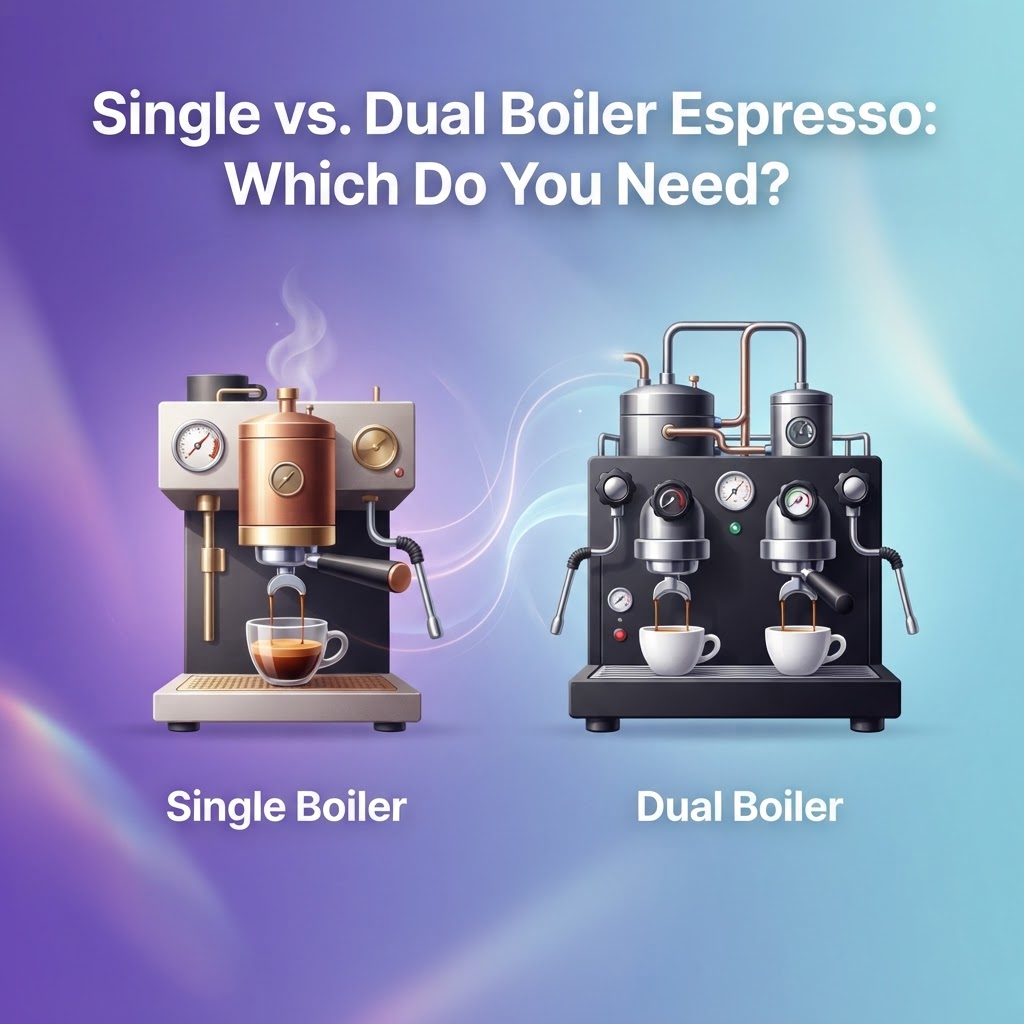
Single vs. Dual Boiler Espresso: Which Do You Need?nnFor aspiring home baristas, the jump from pod machines to semi-automatic espresso makers is an exciting rite of passage. However, staring at a spec sheet can feel like deciphering an engineering manual. The most critical decision you will make is the thermal architecture: single vs. dual boiler espresso machines. Understanding how your machine manages heat is the secret to consistent flavor and efficient mornings.nn## Key Takeawaysnn* Single Boilers: Use one vessel for both brewing and steaming. You must wait for the machine to switch temperatures between tasks, making them better for straight espresso drinkers.n* Dual Boilers: Feature independent boilers for brewing and steaming. This allows for simultaneous operation, which is ideal for those who drink milk-based lattes or entertain guests.n* Efficiency: Dual boiler machines are faster for volume, but require higher upfront investment and more complex maintenance.n* Workflow: If you prioritize speed and lattes, the dual boiler is your best friend. If you stick to Americanos or double shots, a single boiler saves space and money.nn## Understanding Boiler Dynamics in Espresso MachinesnnAt its core, espresso brewing requires two distinct thermal tasks: heating water to roughly 195°F to 205°F for the extraction, and creating steam (typically 250°F+) for frothing milk.nnAccording to the Specialty Coffee Association (SCA), thermal stability is the bedrock of a quality shot. A single boiler machine uses one heater for both tasks, which introduces a waiting period. You brew your shot, then engage a switch to heat the water further to generate steam. Once done, you must "flush" the machine to bring the temperature back down for the next espresso.nnIn contrast, a dual boiler machine provides a dedicated environment for each task. One boiler is constantly primed for extraction, while the other is ready to steam. This removes the "waiting game" entirely.nn## The Workflow Experience: Who Needs What?nn### The Case for the Single BoilernIf you are a solo drinker who prefers a straight espresso, a ristretto, or an Americano, a single boiler is often more than enough. These machines are generally more compact, making them perfect for smaller kitchen counters. They are also easier to service because the plumbing and electrical architecture are less complex.nn### The Case for the Dual BoilernIf you are the household barista who crafts three or more milk-based drinks back-to-back, a dual boiler is a massive quality-of-life upgrade. By removing the need to wait for the machine to heat up or cool down, you can steam your milk while the espresso is still pulling. For those optimizing their home productivity, think of this like using a WebSpikes workflow; by automating the transition between tasks, you eliminate bottlenecks and improve your overall output efficiency.nn## Comparison Table: Which Should You Choose?nn| Feature | Single Boiler | Dual Boiler |n| :--- | :--- | :--- |n| Brew & Steam Simultaneously | No | Yes |n| Warm-up Time | Fast | Slower |n| Price Point | Budget to Mid-range | Premium |n| Best For | Espresso/Americano drinkers | Latte/Cappuccino fans |n| Kitchen Footprint | Small | Large |nn## Technical Maintenance and LongevitynnAny espresso machine is an investment in time as much as money. Descaling—the process of removing mineral buildup—is essential for the longevity of your heating elements. Dual boiler machines contain two heating elements, meaning there are two surfaces where scale can accumulate. While this makes maintenance slightly more involved, many high-end dual boiler units feature advanced PID (Proportional-Integral-Derivative) controllers that monitor temperature stability with precision, ensuring that the water quality remains consistent over years of use.nn## Frequently Asked Questionsnn**Q: Does a dual boiler make better espresso than a single boiler?n*A: Not necessarily. Quality of espresso depends more on the grind size, bean freshness, and puck preparation. A dual boiler offers better workflow consistency, but the flavor profile depends on the machine's pressure stability and thermal accuracy.*nnQ: Can I froth milk with a single boiler machine?n*A: Yes, but you have to wait for the boiler to reach steaming temperature. This takes 30–90 seconds depending on the model, and you cannot pull a shot while doing so.*nnQ: Which setup is better for a beginner?n*A: If you have the budget and the space, a dual boiler is easier to use because you don't have to manage temperature transitions. However, many beginners start with a single boiler to learn the fundamentals of temperature surfing.*nnQ: Are dual boiler machines more energy-efficient?**n*A: Generally, no. Keeping two boilers at high temperatures requires more power. Many high-end units include "ECO modes" to help mitigate this, but expect higher electricity usage compared to a single boiler.*nn## Conclusion: Making Your ChoicennChoosing between a single vs. dual boiler espresso machine is ultimately a balance between your budget, your counter space, and your morning routine. If you find yourself frustrated by the time it takes to prepare multiple lattes, the dual boiler is a logical investment in your daily convenience. If you prefer the simplicity of a pure espresso and want to save space, the single boiler is a reliable workhorse. Whichever path you choose, remember that the best machine is the one you feel confident using every single morning.
#espresso machines#home barista#coffee gear#espresso guide