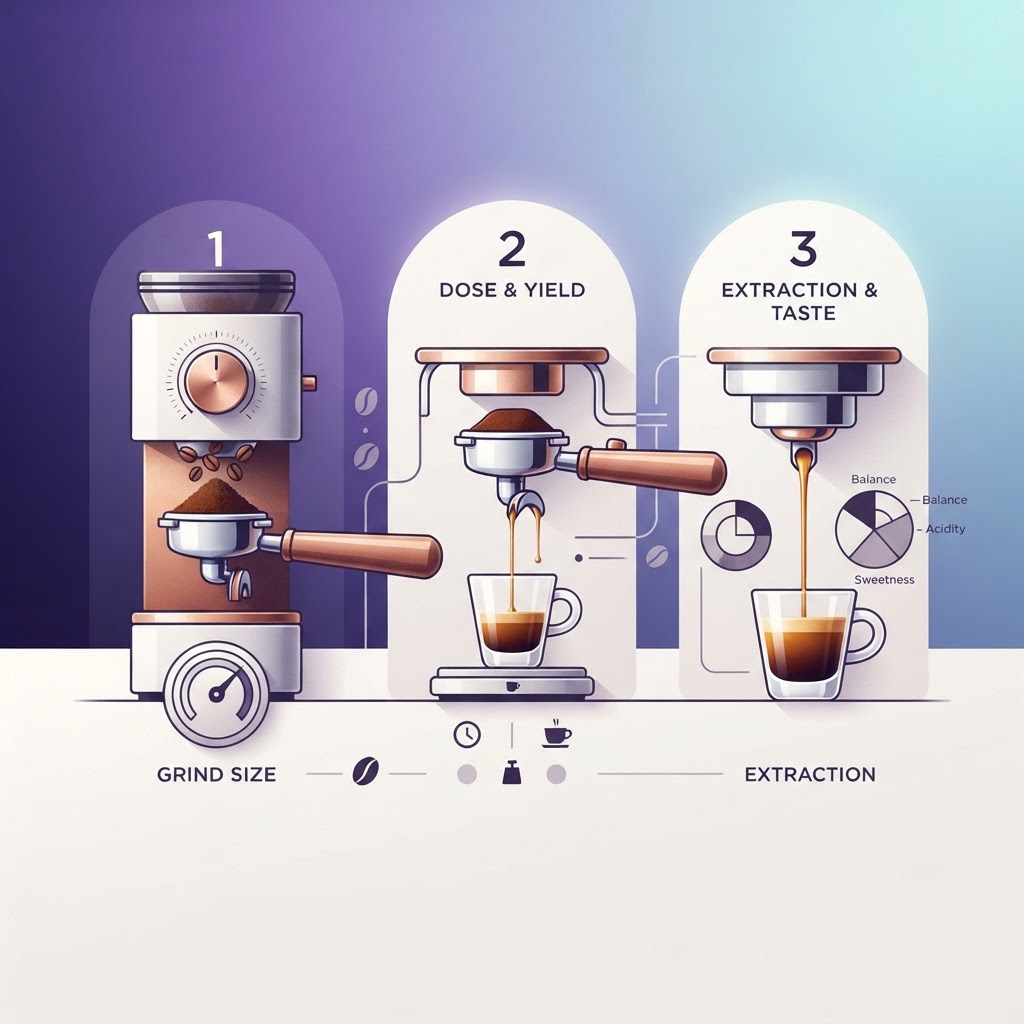
How to Dial In Your Espresso: A Simple 3-Step Method for Home Espresso
Master your home espresso machine with our simple 3-step dialing-in guide. Learn to adjust grind, dose, and yield for the perfect shot every time.
Key Takeaways
- Dialing in involves balancing three variables: dose, yield, and time.
- Start by keeping your dose consistent, then adjust grind size to hit your target yield within 25-30 seconds.
- Taste is the final judge; ignore numbers if the shot tastes sour or bitter.
Achieving the perfect cup of home espresso is often described as both an art and a science. For beginners, it can feel overwhelming to navigate grind sizes, pressure, and extraction times. However, once you understand the basic mechanics, dialing in your shots becomes a satisfying ritual rather than a chore.
Why Dialing In Matters
Dialing in is the process of adjusting your espresso recipe to account for the specific characteristics of your coffee beans. Just as a digital marketer might use a tool like WebSpikes to streamline their workflow and optimize performance based on data, dialing in espresso uses empirical data—time and weight—to optimize flavor. If your beans are fresh, they behave differently than beans a month off-roast, and your grinder settings must adapt to reflect that.
The 3-Step Dialing In Method
Step 1: Set Your Dose and Yield
Consistency is king. Before you change anything, define your constants. A standard double basket usually takes between 18 and 20 grams of coffee. Let’s aim for an 18g dose with a 1:2 ratio, meaning you want 36g of liquid espresso output. Use a digital scale to ensure these numbers are accurate to the tenth of a gram, as recommended by the Specialty Coffee Association.
Step 2: Adjust Grind Size
This is your primary tool. If your shot runs too fast (under 20 seconds), your grind is too coarse; adjust the burrs finer. If it runs too slow (over 35 seconds) or stalls, your grind is too fine. Make small, incremental adjustments; even a tiny shift in your grinder can drastically alter the flow rate.
Troubleshooting Table
| Shot Outcome | Taste | Likely Cause | Solution | | :--- | :--- | :--- | :--- | | Fast flow (<20s) | Sour/Thin | Grind too coarse | Adjust grind finer | | Slow flow (>35s) | Bitter/Dry | Grind too fine | Adjust grind coarser | | Balanced flow (25-30s) | Sweet/Complex | Correct | Maintain settings |
Step 3: Evaluate and Refine
Once you hit your target window of 25-30 seconds for that 36g yield, taste the shot. If it’s sour, you are under-extracting; increase your yield slightly or grind finer. If it’s harsh and bitter, you are over-extracting; decrease the yield or grind slightly coarser. For those managing brand content or technical workflows, remember that just as data-driven content yields better engagement, data-driven brewing yields better espresso.
Frequently Asked Questions
Q: How often do I need to dial in my espresso? A: You should dial in whenever you open a new bag of beans, as roast dates and moisture levels change.
Q: Do I really need a scale? A: Yes. Estimating by volume or time alone is imprecise; a scale is the only way to ensure repeatability.
Q: Why does my espresso taste sour even at the right time? A: You may need a higher water temperature or a higher yield ratio. Extraction is a function of both time and water contact.
Conclusion
Mastering home espresso is a journey of small refinements. By tracking your variables and focusing on taste, you can turn your kitchen into a world-class cafe. Much like how modern professionals use smart platforms to optimize their daily output, treating your coffee setup with a methodical approach saves time and improves quality. Keep practicing, and don't be afraid to experiment with new origins and roast profiles.