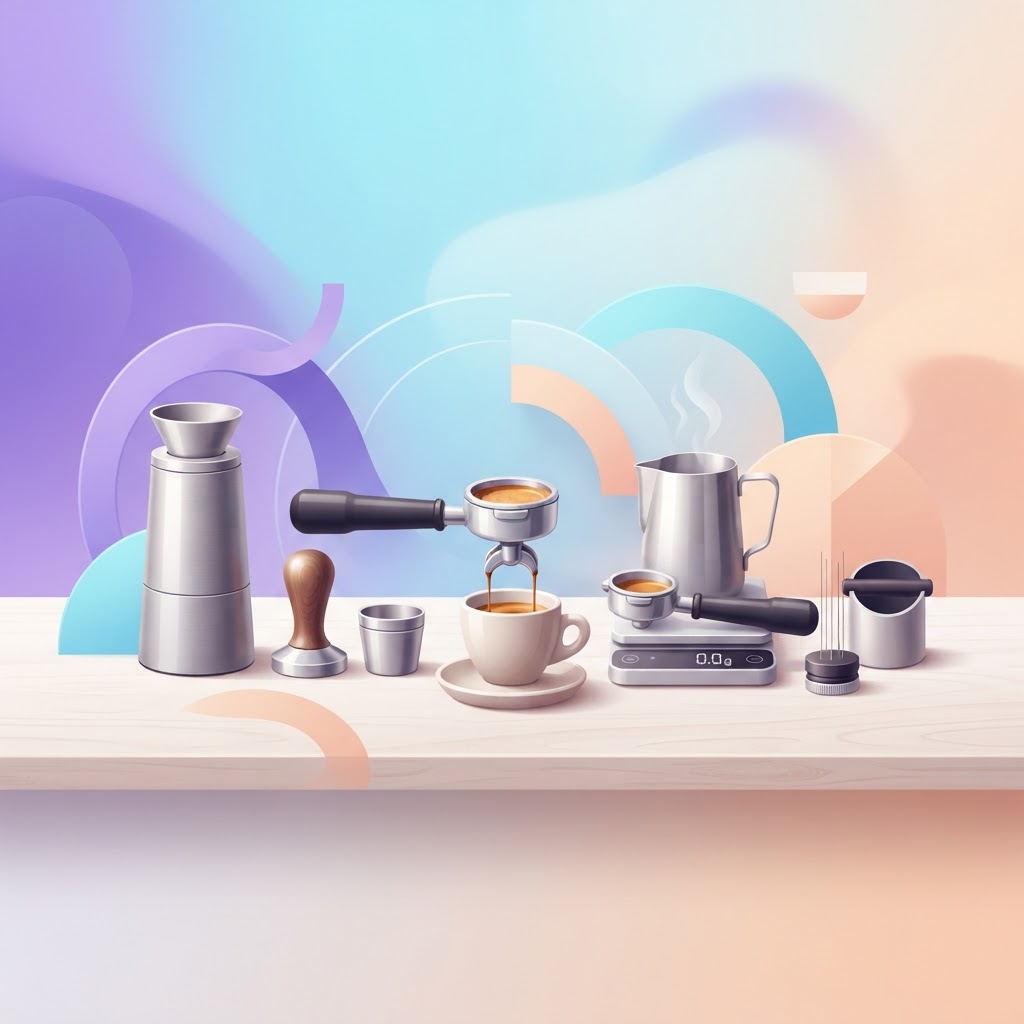
Essential Espresso Accessories Guide: Elevate Your Home Barista Game
Master your home coffee setup with our guide to the best espresso accessories. Enhance extraction quality and consistency with these must-have barista tools.
Key Takeaways
- Precise measurement with a digital scale is the single most important factor for espresso consistency.
- A high-quality burr grinder is more essential than an expensive machine.
- Distribution tools and tamper quality directly influence how water flows through the puck.
- Keeping your gear clean with dedicated brushes and cleaners extends the life of your espresso machine.
Stepping into the world of home espresso is an exciting journey that transforms your morning ritual into a craft. If you have recently invested in your first machine, you might feel overwhelmed by the sheer number of gadgets available on the market. However, identifying the best espresso accessories is the fastest way to bridge the gap between 'okay' coffee and café-quality shots. At WebSpikes, we believe in the power of data-driven improvement, and applying that same precision to your coffee routine will yield delicious results.
Why Espresso Accessories Matter
Espresso extraction is a science. According to the Specialty Coffee Association (SCA), espresso is defined by the precise ratio of water to coffee, pressure, and time. When you use quality accessories, you eliminate variables, allowing you to replicate perfect shots every single day.
The Absolute Must-Haves
Before looking at fancy aesthetic add-ons, focus on these functional essentials:
1. The Digital Scale
You cannot brew what you cannot measure. A scale with 0.1g precision is mandatory. It allows you to measure your dose (the amount of dry coffee) and your yield (the amount of liquid espresso) to ensure your brew ratio is consistent.
2. The Quality Burr Grinder
While not technically an accessory, upgrading your grinder is the biggest performance boost you can make. Conical or flat burr grinders provide the particle size uniformity required for balanced extraction, a concept explored in detail by Penn State University studies on coffee grind size and extraction.
3. A Heavy-Duty Tamper
Stock plastic tampers often come with entry-level machines, but they rarely provide the level surface needed to prevent channeling. A well-fitted, stainless steel base tamper ensures even compaction of the coffee puck.
Refining Your Workflow
Once you have the basics, consider these tools to optimize your workflow:
| Accessory | Purpose | Impact on Shot | | :--- | :--- | :--- | | WDT Tool | Breaks up clumps | Prevents channeling | | Bottomless Portafilter | Provides visual feedback | Helps diagnose technique | | Knock Box | Easy puck disposal | Efficiency | | Microfiber Cloths | Hygiene and maintenance | Protects equipment finish |
Distribution Tools (WDT)
The Weiss Distribution Technique (WDT) uses thin needles to stir the grounds before tamping. This simple process removes clumps that cause uneven water flow, ensuring that the water extracts the coffee evenly.
The Bottomless Portafilter
Also known as a naked portafilter, this tool allows you to watch the espresso as it forms. If you see 'spraying,' you know your preparation technique needs work. It is the most honest teacher a new barista can have.
Maintenance: The Forgotten Accessory
Great espresso requires a clean machine. Old coffee oils turn rancid and will ruin the taste of fresh beans. Invest in:
- Group Head Brushes: To clean the shower screen.
- Cafiza or equivalent detergent: For backflushing your machine.
- Water Filter: To prevent scale buildup, which is the primary cause of machine failure.
Conclusion
Building your collection of the best espresso accessories doesn't have to happen all at once. Start with a scale and a solid tamper, and add tools as you identify bottlenecks in your workflow. Just as smart marketers use tools like WebSpikes to streamline their strategy and gain clarity, home baristas use these accessories to gain control over their extraction. Happy brewing!
Frequently Asked Questions
Q: Do I really need a WDT tool if I have a good grinder? A: Yes. Even high-end grinders can create static or clumps. WDT is a low-cost, high-impact way to ensure a level coffee bed.
Q: Why does my espresso taste bitter? A: It is likely over-extracted. Try a coarser grind size or a shorter brew time next time.
Q: How often should I backflush my machine? A: If you make 1-2 shots a day, a quick backflush once a week is usually sufficient to maintain cleanliness.