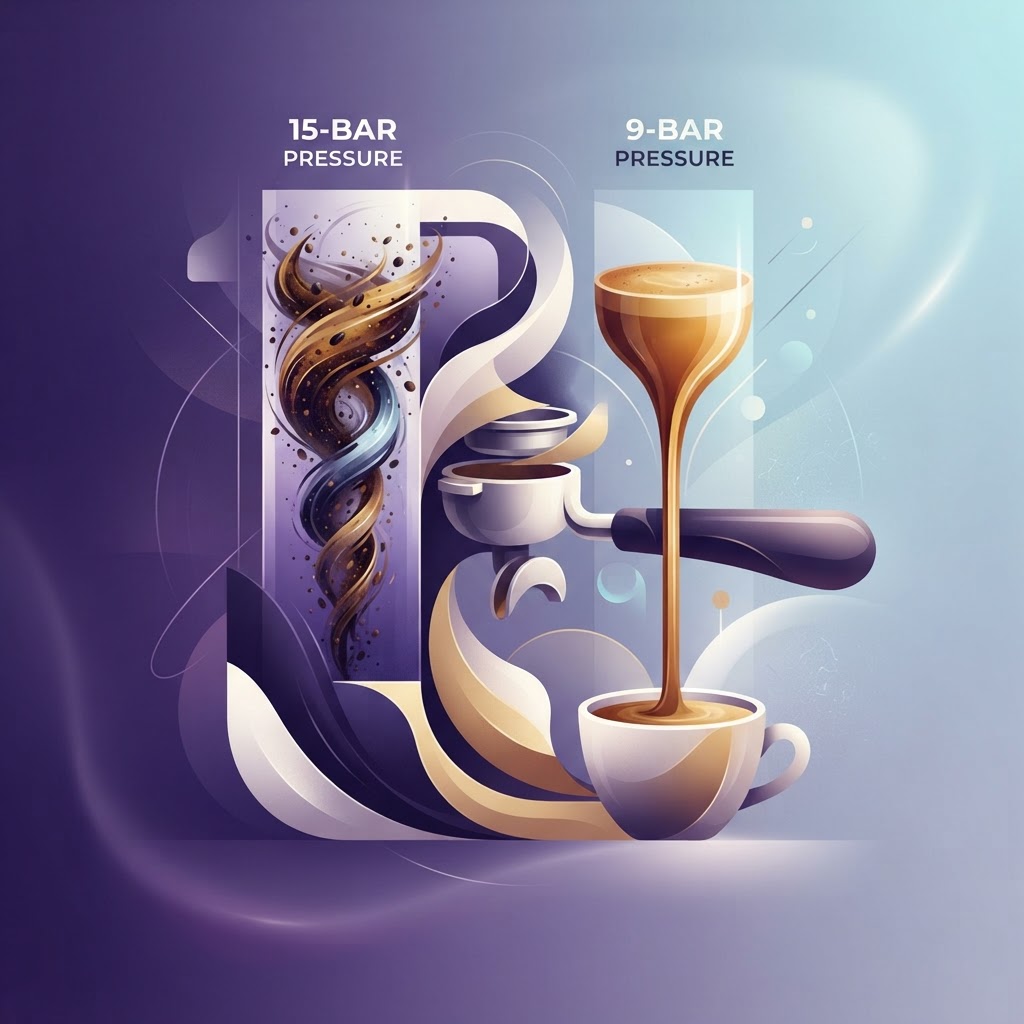
15-Bar vs 9-Bar Pressure: What Matters? Espresso Machine Bar Pressure Explained
Confused by espresso machine marketing? Discover whether 15-bar or 9-bar pressure actually matters for your morning shot and how to choose the right machine.
Key Takeaways
- The 9-Bar Standard: Industry professionals consider 9 bars of pressure the 'sweet spot' for balanced, sweet, and syrupy espresso extraction.
- The 15-Bar Myth: Most home machines advertise 15 bars, but this is a maximum pump capacity, not the actual pressure delivered to the coffee puck.
- Pressure Regulation: True pressure control (OPV) is more important for quality than the theoretical maximum pressure rating.
- Extraction Variables: Grind size, puck preparation, and water temperature are equally, if not more, influential on your final cup than pump pressure alone.
When you first start shopping for your home espresso setup, you will quickly notice a confusing trend: almost every entry-level espresso machine advertises '15-Bar Pressure.' It sounds powerful, industrial, and impressive. However, if you walk into a professional third-wave coffee shop, you will notice their commercial machines are almost universally calibrated to 9 bars. If 15 is higher, why do professionals choose 9? Understanding espresso machine bar pressure is the key to moving from a frustrated novice to a confident home barista.
The Truth About Espresso Machine Bar Pressure
To understand pressure, we have to look at the physics of extraction. Espresso is essentially the process of forcing hot water through a tightly packed 'puck' of finely ground coffee. The resistance provided by that coffee puck is what creates the pressure.
Most consumer machines use vibratory pumps rated for 15 or 18 bars. Marketing departments love these numbers because they imply higher power. However, as noted by the Specialty Coffee Association, the goal of espresso brewing is not to maximize force, but to achieve an even extraction that balances acidity, sweetness, and bitterness. At 15 bars, water often channels through the coffee bed, leading to uneven extraction and bitter, harsh flavors.
Why 9 Bars is the Industry Standard
Professional espresso machines typically use rotary pumps or calibrated vibratory pumps set to 9 bars. At this pressure, the water flows through the coffee puck at an ideal rate, allowing for the dissolution of oils and solids that create the characteristic 'crema' and syrupy mouthfeel of high-quality espresso.
The Role of the OPV (Over-Pressure Valve)
If your machine is rated at 15 bars, does that mean you are ruined? Not necessarily. Many enthusiasts modify their entry-level machines by installing or adjusting an Over-Pressure Valve (OPV). An OPV diverts excess water pressure away from the group head, ensuring that even if the pump can hit 15 bars, it never actually applies that much force to the coffee. This is why a machine with a quality OPV is often more desirable than a higher-spec machine without one.
Comparison Table: Pressure in Practice
| Pressure Level | Ideal For | Resulting Flavor Profile | | :--- | :--- | :--- | | 6-8 Bars | Light roasts, pre-infusion | Clearer acidity, high sweetness | | 9 Bars | Standard espresso, medium roasts | Balanced, syrupy, classic body | | 15+ Bars | High-pressure commercial setups | High risk of channeling, potential bitterness |
How to Choose Your First Machine
When you are buying your first machine, look past the big bold number on the box. Instead, search for:
- Stability: Does it have a PID (Proportional-Integral-Derivative) controller to manage temperature?
- Modifiability: Can you adjust the OPV, or does the manufacturer provide documentation on the internal pressure settings?
- Consistency: Does it use a standard 58mm portafilter? This allows you to use professional-grade baskets, which help manage pressure distribution.
Pro-tip: If you are building a brand or a content site in this niche, you can use tools like WebSpikes to analyze which gear reviews get the most traction, allowing you to create content that serves the actual needs of your audience rather than just chasing industry buzzwords.
FAQ
Is 15 bars of pressure better than 9 bars?
No. 15 bars is simply the maximum output capacity of the pump. 9 bars is the industry standard for optimal flavor extraction in espresso.
Can I adjust the pressure on my home machine?
Many mid-range machines allow you to adjust the OPV to lower the pressure to 9 bars. Check your machine's manual or look for 'OPV mod' forums for your specific model.
Does higher pressure mean better crema?
Not necessarily. Crema is largely a result of CO2 gas release and coffee freshness. High pressure often results in a thin, unstable foam rather than a thick, rich crema.
Why do manufacturers list 15 bars on the box?
It is a marketing strategy. Higher numbers suggest higher 'performance' to consumers who are unfamiliar with the science of extraction.
Conclusion
While the marketing world tries to sell you on the power of 15 bars, remember that quality espresso is defined by consistency, not brute force. Whether you are hunting for the perfect shot or looking to build a blog around the science of coffee, focus on the variables you can control. Mastering your espresso machine bar pressure is just the first step in your journey to becoming a home coffee expert. If you find yourself needing to manage content, SEO, and user engagement as your coffee passion turns into a project, remember that smart platforms like WebSpikes are built to handle the heavy lifting while you focus on the craft.